
Walking games
How to make walking more fun when you already know you should walk
Short answer: give the walk a second job, and pick one whose momentum does not depend on you. Most advice here (a podcast, a new route) only works for people who already enjoy walking and need it topped up. If you do not enjoy it, you need something that pulls you out the door rather than something that decorates the walk once you are already on it.
Every article on this subject says the same four things: listen to a podcast, take a different route, bring a friend, walk somewhere pretty. That advice is fine, and it is written for someone who already likes walking and has hit a dull patch.
If you genuinely do not enjoy walking, none of it helps, because all four require you to already be outside. This page sorts the options by the only thing that matters for that person: how much of the work you have to do yourself.
Why is walking boring?
Three things are true at once. Walking is not hard enough to occupy your attention, unlike running. It repeats, because the route near your house is finite. And nothing accumulates during it, so at minute 20 you are exactly where you were at minute 10, except more bored.
That is a design problem, not a discipline problem. The fix is to put something in the empty space, and the useful question is who supplies the momentum: you, or the thing you attached.
Which options pull you out the door?
These three have their own momentum. Something is happening whether or not you feel like walking today, and going out is how you get at it. That is the whole difference. This tier works for people who do not like walking, because it does not ask you to supply the enthusiasm yourself.
A serialised story you are only allowed on walks
Not a podcast. A long audiobook or a serialised audio drama with a cliffhanger, rationed strictly to walks. The rule is the mechanism: no listening on the sofa, in the car or while washing up. The story keeps moving in your head and the only way to hear the next part is to put your shoes on.
A standing appointment with a person
The weekly phone call to your brother becomes the walk. A walking group with a time on it. A friend who is outside your door at 7pm whether you feel like it or not. An appointment is much harder to skip than an intention, because skipping it now costs someone else something.
A game where progress needs your steps
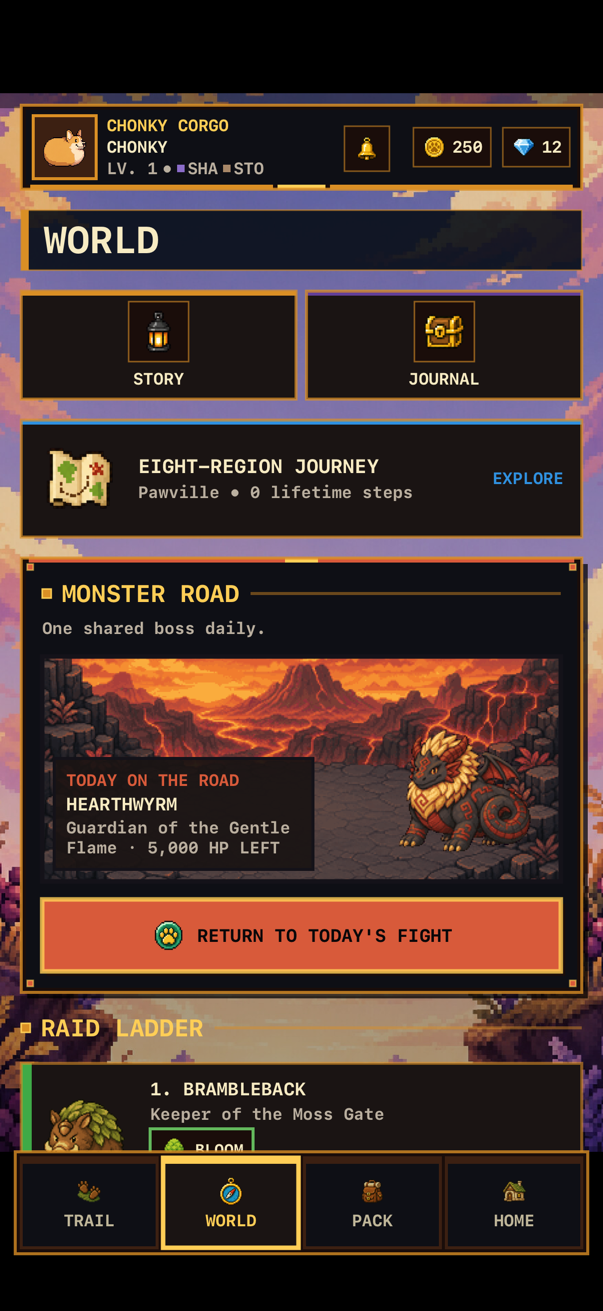
Pokemon GO, Zombies Run, Pikmin Bloom, Walkr and Chonky Corgo all do the same structural thing in different costumes: something you want to see happen only happens if you move. The walk stops being the activity and becomes the input. This is the only tier-1 option that works when you have nobody to call and no commute to redesign.
Which options make an existing walk better?
These need you to already be walking. They are genuinely good and worth doing, and they are also what almost every other article on this topic offers as the whole answer. Reach for them once tier one has you out of the house on most days, not before.
- A street on the map you have never walked down. Open your maps app and find one. Most people have a surprising number within a mile, and the novelty does all the work for free.
- Walking an errand instead of driving it. The post office, the return, the thing you keep meaning to collect. A walk with a destination stops feeling like exercise.
- A different time of day. The same route at 6am and at 9pm are two different places. If your walk is always the 6pm one, you have been walking the same ten minutes for a year.
- A camera brief. Give yourself one thing to photograph: doors, cats, anything red. It turns a walk into a small hunt.
- Intervals, for texture not fitness. Walk fast to the third lamp post, normal to the next, repeat. It gives the walk a shape it did not have.
- A borrowed dog. Neighbours and rescue centres are both more enthusiastic about this than people expect.
Do walking games actually work?
This is the one option on the page with measured evidence behind it, which is unusual for advice of this kind. Two independent analyses using device data rather than self-report both found roughly 1,450 extra steps a day among Pokemon GO players, and one of them found something more interesting than the headline.
Researchers at Stanford and Microsoft studied 32,000 Microsoft Band users over three months in 2016, identifying Pokemon GO players through their search queries and measuring activity with accelerometers rather than self-report. Engaged players increased their activity by an average of 1,473 steps a day, more than 25% above their own prior baseline.
The finding that matters most is not the headline number. The same study looked at four leading mobile health apps and found they drew overwhelmingly from people who were already very active. Pokemon GO increased activity across men and women of all ages, weight categories and prior activity levels, including people who were not active to begin with. A game reached the population that fitness apps structurally could not.
A 2020 systematic review in the American Journal of Preventive Medicine pooled 17 studies covering 33,108 participants and landed in the same place: an increase of about 1,446 steps a day, with players also spending less time sedentary.
Does the effect last?
No, and the 2020 review is blunt about it. The increase was statistically significant but clinically modest, and the review names retaining engagement once the initial novelty wears off as the open challenge. The 2016 study measured a 30 day window and said plainly that long-term effects needed further study.
That limitation applies to every idea on this page rather than only to games. So do not expect any single trick to carry you for a year. Expect each one to carry you for a few weeks. That is still useful if you have three or four and rotate them. The durable skill is not finding the perfect solution, it is noticing when a walk has gone stale and changing something about it before you stop going.
What should you do tomorrow?
Pick the tier-1 option that needs nothing bought and nobody asked. For most people that is either a long audiobook rationed to walks only, or a walking game on the phone already in your pocket. Do that one for two weeks.
If it goes stale after a month, the routine is working and the content needs changing, which is a much easier problem than the one you started with.
And if the reason you stopped walking turns out to be the number your app assigned you rather than the walk itself, that is a different problem. The research on what a good step goal actually is is in what is a good step goal.
What else do people ask?
Four questions that come up once someone accepts that boredom is the actual obstacle rather than laziness. The answers stay with what has been measured where measurements exist, and say plainly where they do not, which is most of the advice in this category.
- How do I make walking more fun on my own?
- Attach something with its own momentum to the walk, rather than something that only improves a walk you are already taking. A long audiobook rationed strictly to walks, or a game whose progress needs your steps, both work without another person involved.
- Do walking games actually increase how much people walk?
- In the short term, yes. Two independent analyses using device data rather than self-report found around 1,450 extra steps a day among Pokemon GO players. Both also flagged that the effect fades as novelty wears off, which is the honest caveat.
- Is it bad to always listen to something while walking?
- Not for the walking. The step count and the movement are the same either way. The trade-off is that you lose the quiet, which some people specifically walk for, so keeping one walk a week without headphones is a reasonable compromise.
- What if I live somewhere with nothing interesting to walk to?
- Then the fix has to travel with you rather than be out there, which points at audio and games rather than routes and errands. A long audiobook rationed to walks works in a car park as well as it works in a forest.